The short version
Disaster relief food is designed for calories, not recovery. In six weeks we designed, prototyped and filed patents for a food pack that grows microgreens inside its own packaging.
Relief aid solves for calories, not recovery
About 160 million people are displaced by natural disasters every year. Standard relief packets of rice, oil, biscuits and canned food stop hunger but lack the vitamins and minerals found in fresh produce. For people who are injured and traumatised, poor nutrition slows healing and raises the risk of disease.
Fresh food doesn't solve it either. Floods contaminate local produce, disrupt supply chains for weeks, and leave shelters too crowded to store anything bulky.
The user and the buyer are different people with different constraints
The person eating it
Displaced and often injured, with nowhere to cook, store or clean food safely.
Needs: safe, ready-to-eat food that supports recovery over days and weeks.
The agency distributing it
Relief organisations moving aid in bulk through damaged infrastructure on tight budgets.
Needs: low unit cost, a long shelf life, packs that stack and travel, and no contamination risk.
We tested three directions against both sets of needs
| Direction | Why it fell short or won |
|---|---|
| Edible packaging | Novel, but didn't address the nutrition gap |
| Nutrition concentrates | Specialised nutrition packages already exist. Logistics and cost keep them from reaching people |
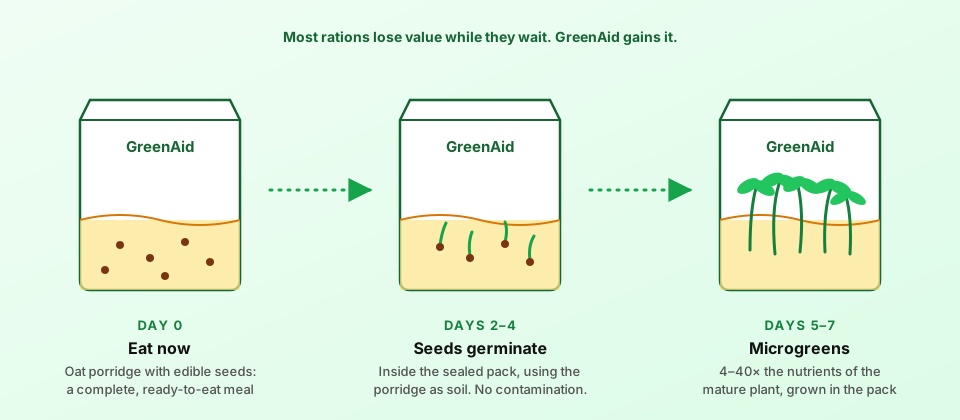
| Food that grows food (chosen) | Ready-to-eat oat porridge with edible seeds. Eaten immediately, it's a complete meal. Stored for 5–7 days, the seeds grow into microgreens with no soil, using the porridge as the growing medium |
The insight that made it work
Every other ration loses value while it waits to be eaten. GreenAid gains value, because microgreens are 4–40 times more nutritious than the mature plants. The relief system's biggest weakness, long delays, becomes part of the product.
Each constraint became a requirement
- Cost: a target price of ₹25–45 per pack, so it can be distributed in bulk.
- Safety: a porridge recipe that supports germination but not mould, using potassium sorbate, a common food-grade preservative.
- Logistics: six-layer Tetra Pak-style packaging that resists floodwater and impact, stacks efficiently and keeps seeds separate until activated.
- Usability: an origami-inspired seed compartment that releases seeds inside the sealed pack, so it is never opened in contaminated conditions.
- Seed choice: varieties picked for reliable 5–7 day germination, nutritional density and taste as both seed and microgreen.
Designed to be defensible from the start
The programme required a provisional patent at the end, so novelty, non-obviousness and prior art shaped design decisions from week one rather than being checked at the end.
Several organisations approached us about developing GreenAid. The gating risk before launch is lab-tested food safety, so that is the next milestone.
Design for the buyer and the user
Aid succeeds only if it works for the agency moving it and the person eating it.
Turn a constraint into the value proposition
Delay was the system's weakness. GreenAid made it a feature.
Treat IP as a design constraint
Thinking about defensibility early made the concept sharper.
See how it was designed
Visual research, recipe testing, seed selection and packaging design.
Design case study →